Soldiers of The Great War had a particular type of gallows humour, a dark, sardonic world view that helped them cope with ever present and imminent death. You can see it in their letters home and in the names they gave to places on the battlefield, like Hellfire Corner. Yet, the trenches and bunkers along the River Yser north of the pretty town of Diksmuide held a special horror that’s hard to mock. Even by First World War standards, the Trench of Death was not a place you wanted to find yourself.
When the German armies invaded Belgium in 1914, they met fierce but ultimately futile resistance. Despite their best efforts, the Belgian army had to retreat in the face of overwhelming odds until they reached the River Yser in the very west of Flanders. Here, a combined Belgian and French force halted the German advance. Under massive pressure the Belgians opened the dykes, flooding the land to stop further German gains, and dug in.


As the open warfare of 1914 turned to static, attritional trench warfare, the Trench of Death became the boundary between German occupied Belgium and the last remaining area of free and independent Belgium. Diksmuide was reduced to rubble and Belgian forces would endure horrific conditions along this section of the Western Front, but even in the great German offensive of 1918, this region remained in Belgian hands.
The Germans had secured a bridgehead across the Yser in 1914 and heavily fortified it. The Trench of Death came within 50m of a German bunker, as a result soldiers in the trench were subjected to near constant machine gun and mortar fire. That stalemate lasted until 1918. Recognising that sacrifice, but also the political significance of the last free area of Belgium, 1 km of the trench system has been preserved.


The site is open to the public and there is a good interpretation centre next door that explores the history of the conflict in this remote corner of Flanders. I visited the Trench of Death and then walked to Vladslo German Military Cemetery. It was a long walk in the countryside, but this is a special cemetery. Amongst the 25,644 soldiers buried here is Peter Kollwitz, the 18 year old son of German artist Käthe Kollwitz.
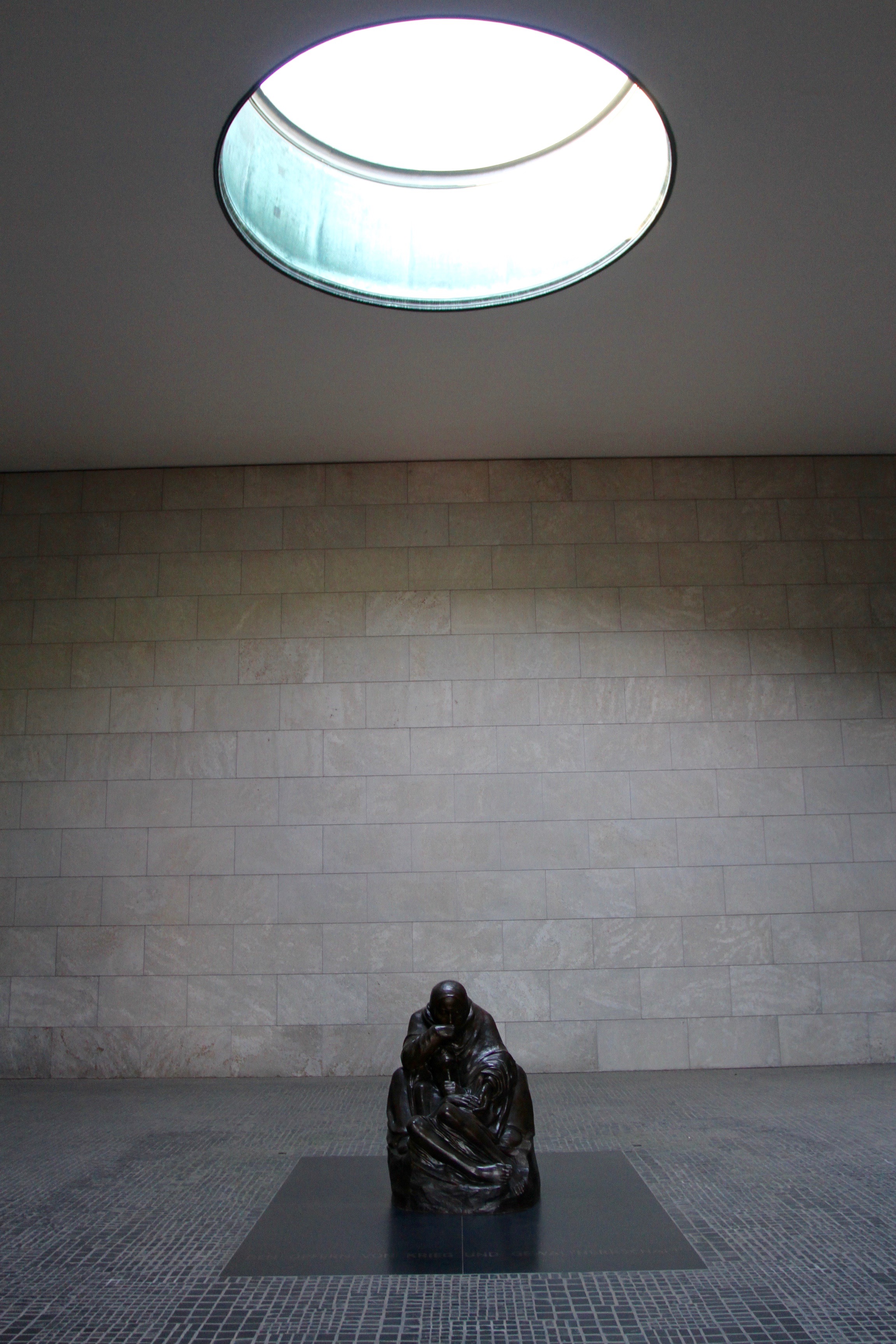
Käthe Kollwitz’s statue, Mother with her dead son, graces the Neue Wache on Berlin’s Unter den Linden. It is one of the defining anti-war statues to come out of the First World War. It was born out of her own grief of losing her son in a war she opposed. At the rear of the Vladslo cemetery is another of her sculptures, The Mourning Parents. They bear silent witness to the destruction and loss of life felt by many in Germany.


I’m a fan of Kollwitz’s work and really wanted to see the cemetery and statues. I arrived through the Praetbos, a wood that was in the German rear where soldiers arriving at the front trained or where soldiers came to rest after they had been in combat. It is a peaceful and relaxing place today, but later in the war the Germans built a second defensive line in the woods and concrete bunkers can still be spotted here.
I found myself alone in the cemetery. It was a calm, tranquil place, the headstones flat to the earth and surrounded by oak trees. It had a very different feel to the Commonwealth cemeteries, less martial, more reflective – more so with Kollwitz’s memorial dedicated to her son and his comrades. I spent some time here before heading on the long walk back to Diksmuide and a well deserved lunch.


Even if you’re not interested in the First World War, Diksmuide is worth a visit. Much like Ypres, its historic heart was rebuilt to recreate its ancient medieval centre after the war. It is a history that begins in the 9th century, it gained a town charter in the 11th century and, as its strategic position on the Yser made it rich, defensive walls in the 13th century. There is also a 13th century Beguinage.
The Grote Markt is lovely, surrounded by gabled buildings and backed by the hulking Sint-Niklaaskerk. I had lunch at a brasserie on the square and then went for a stroll. It’s a small place and doesn’t take long to explore. I landed at the Yser Tower, a memorial to the war dead. The original tower was blown up in 1946 by Belgian Resistance fighters due to the collaboration between Flemish nationalists and the occupying German forces of another, even more terrible war.

Ever present “Pólemos”.
(War in Greek. I don’t do much Greek. Just a research I did)
Stay safe.
I was in Normandy during the summer and was very moved by the different cemeteries and how different nations remember their dead. Flanders is high on my list. I’ll be coming back to this post. Thank you.
I have yet to visit the Normandy beaches and the surrounding area, I imagine just as moving as nearby Flanders Fields.