We’d seen the posters for a retrospective of Paul Delvaux around Brussels for several months (advertising works apparently). I knew nothing of his work, but the images in the posters were intriguing and we thought it would be good to find out more about one of Belgium’s most famous artists. So, on the final day of the exhibition, we hopped on a train to Liege and La Boverie.
Delvaux’s youth was overshadowed by the First World War, his adulthood in the shadow if the Nazi occupation of Belgium. In between, he had lived through the Great Depression and despite coming from a well-to-do family, the trauma is clearly visible in his art. Some of his paintings don’t make for comfortable viewing and there is no doubt that he set out to shock – a goal still achieved today and not just because of the many female nudes.


Viewing his images of women, many naked, some maternal and naked, some skeletons, it is not surprising to discover that Delvaux’s mother, the musician Laure Jamotte, was a dominant and domineering presence in his life. To describe his upbringing as ‘repressed’ seems an understatement. This maternal repression found voice in surrealism, and in his obsession with painting women as, what might be described as, sexualised mannequins.
For a flavour of the control Delvaux’s mother exerted over him, in 1929 he met and fell deeply in love with Anne-Marie de Maertelaere, known as Tam. His mother forced him to leave her and to promise he would never see her again. His mother died in 1932, but he had already lost touch with Tam. Instead, he entered into a ‘marriage of convenience’ with Suzanne Purnal in 1937.


Fate though had another twist. In 1947, he had a chance encounter with Tam. They were soon seeing each other again and a year later he divorced his (presumably long suffering) wife. Tam and Delvaux married in 1952 and were inseparable until her death. With a background like that it is not surprising that Delvaux’s art is both bizarre and fascinating, or that it involves a lot of naked women in unusual settings.
Not that that put off the large groups of elderly Belgians who crammed into La Boverie. It seemed like everyone had waited until the last day. We emerged out of the exhibition into a day transformed from grey and cloudy to blue skies and sun. We decided to have a walk into Liege, grab lunch and do some sightseeing. We walked along the river until we arrived at the pedestrian bridge opposite the university.


I have a soft spot for Liege. Its recent history hasn’t been kind and it is cloaked in an air of post-industrial decline that is hard to ignore. Yet, it is a pleasant place with a rich history that has many reasons to visit. It might be a bit grubby on the outside but, with the right attitude, Liege is a great city to while away a day (or two). We started with a lunch of Boulets à la Liégeoise and beer at Brasserie C.
Nearby is one of Liege’s most extraordinary sights, the preposterously steep stairs known as Montagne de Bueren. Around the rest of this area are a series of narrow alleyways leading into courtyards lined with houses. These were often associated with abbeys and nunneries. The nearby Eglise Notre-Dame-de-l’Immaculée-Conception and Eglise Saint-Barthélemy are reminders of this history.


We headed to the Place du Marché, a square with several bars opposite the Hôtel de Ville. In a window was a strange art display of a pink, messy bedroom that may have been a comment of the sexualisation of girls – or possibly something entirely different. Close by is the medieval Palace of the Prince-Bishops – who would have disapproved of the pink bedroom and Paul Delvaux. The palace dates to the 16th century and is impressively big.
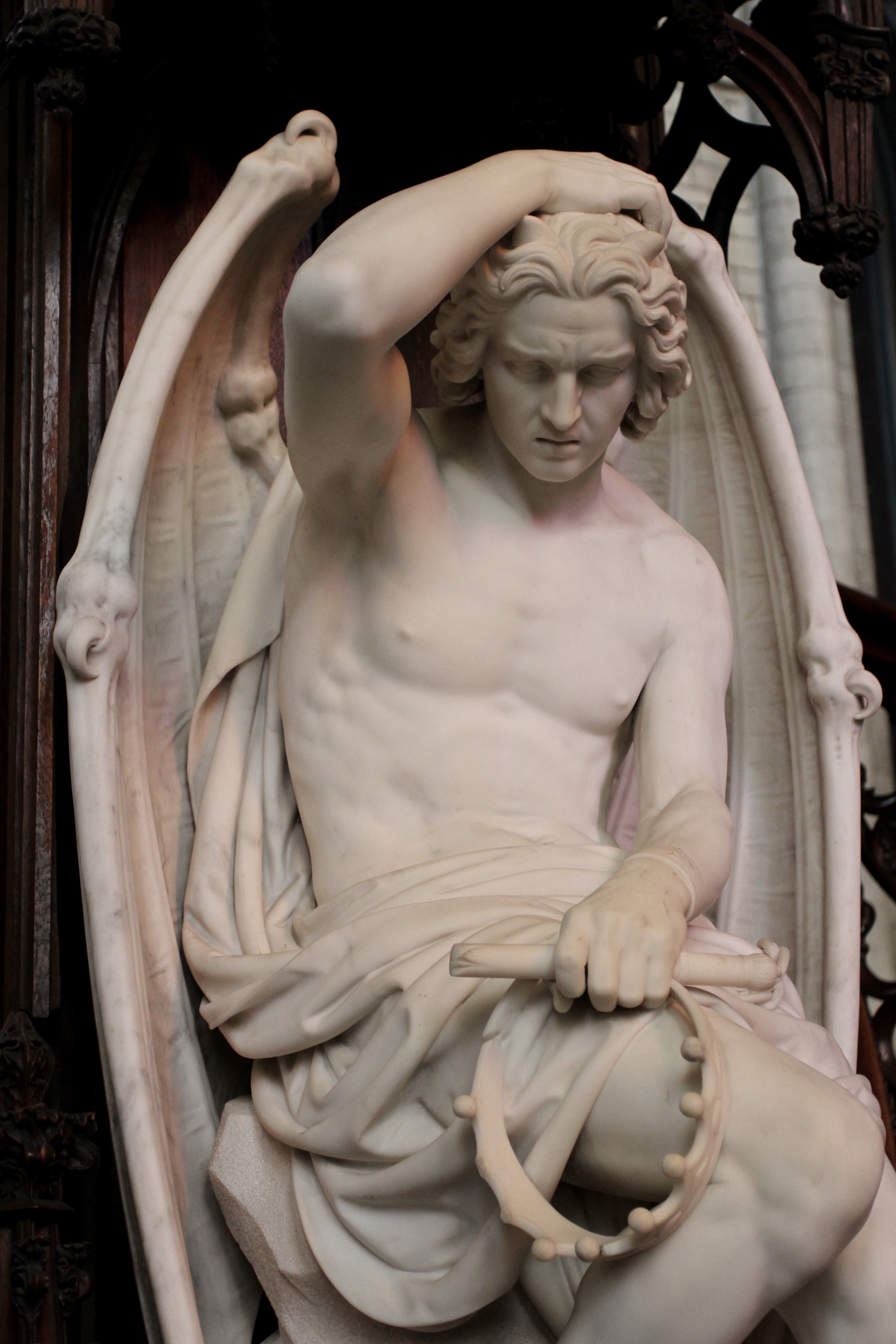
We had one more stop to make on the way back to the train station: a visit with Lucifer in the Cathédrale Saint-Paul. Liege is one of the few places to host a statue of the Fallen Angel in a church. It’s said that the first sculpture was too attractive. Fearing for the souls of parishoners, it was replaced. There was just time to be lured into yet another art show before heading back to Liege’s famous Guillemins train station.

Delvaux is a good artist, whatever his “foibles” were. (Many artists were basket cases anyway.)
Tot ziens Paul
https://operasandcycling.com/category/belgium/liege/